
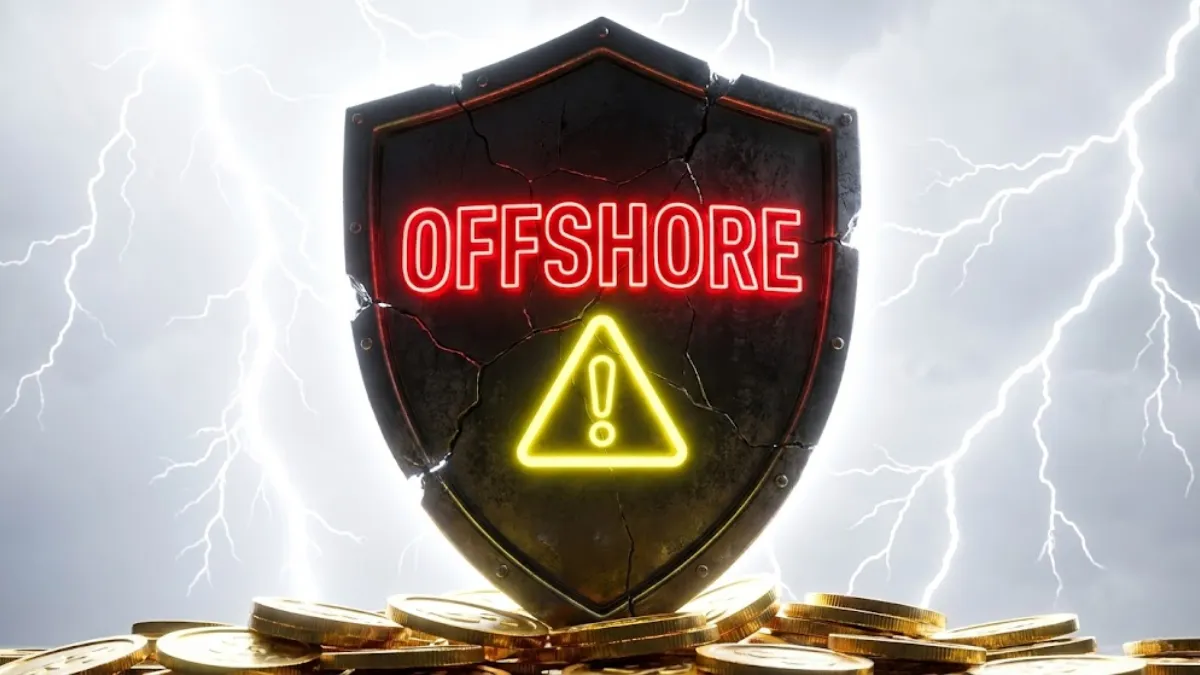
Want 1:500 High Leverage? First, Understand the Massive Difference Between "Group Subsidiaries" and "Standalone Scam Brokers"
Foreword: Why was I "exiled" to a small island?
It represents one of the most terrifying moments for global forex investors: You’ve spent ages researching and finally decided to open an account with a renowned international broker.But when you receive the "Account Opened Successfully" email, you notice the contracting entity on the agreement says: "Governed by the laws of Saint Vincent" or "Regulated in The Bahamas".
Alarm bells might instantly ring in your head: "Wait, didn't I choose a big UK company? Have I stumbled upon a scam site?"
Don't panic just yet. In 2026, this is usually not a scam, but rather the industry's "standard operating procedure." However, that doesn't mean all offshore regulation is safe.
This article will reveal the "offshore truth" of the forex market. We will deeply compare the essential differences between Saint Vincent (SVG) and The Bahamas (SCB), and teach you a golden rule to distinguish which offshore accounts are safe to use, and which ones you must close immediately.
Core Background: Why do big brokers push you offshore?
To understand offshore regulation, you first need to understand "leverage restrictions."Over the past few years, in order to protect retail investors, global Tier 1 regulatory bodies have jointly launched a "de-leveraging" campaign:
- UK (FCA): Max leverage capped at 1:30.
- Australia (ASIC): Max leverage capped at 1:30.
- EU (ESMA): Max leverage capped at 1:30.
This means if you insist on staying under these top-tier regulations, your $1,000 capital can only be used as $30,000. But for many mature traders accustomed to high leverage of 1:400 or even 1:500, this makes trading practically impossible.
To retain these clients, major international brokers came up with a compromise: the "Offshore Subsidiary Strategy".
They establish subsidiaries in offshore financial centers with looser regulations, specifically to serve international clients seeking high leverage.
Truth Analysis: Not all "Offshore" is the same
Many people lump all small island jurisdictions together, which is a huge mistake. In the offshore world, there are also "hierarchy levels." Let's take the two most common regions as examples:1. Saint Vincent (SVG FSA) — This is "Registration," NOT "Regulation"
Saint Vincent and the Grenadines is an absolute outlier.Please remember: The SVG FSA has publicly stated multiple times that they DO NOT "regulate" Forex margin trading.
- Substantive Meaning: Setting up a forex broker here is like registering a generic trading company. No huge capital bond is required, no regular audits are needed, and no one questions the flow of funds.
- Risk Level: Extremely High. Legally speaking, this is a state of "non-regulation."
2. The Bahamas (SCB) / Cayman Islands (CIMA) — This is "Light Regulation"
In contrast, the Securities Commission of The Bahamas (SCB) or the Cayman Islands (CIMA) are actual regulatory bodies.- Substantive Meaning: To get a license here, brokers usually need to:
- Establish a physical local office.
- Pay a certain amount of registered capital (usually in the hundreds of thousands to millions of dollars range).
- Submit audit reports.
- Risk Level: Medium. Although there is no government compensation scheme, there is at least a regulator watching, so they can't just run away whenever they want.
The Golden Rule: How to judge if your offshore account is safe?
Since offshore regulation carries higher risks, why do some top-tier brokers (like Exness, XM, etc.) still place clients offshore?This is where we teach you the "Mr.Forex Offshore Screening Method".
The key to judging safety lies not in the offshore license itself, but in "WHO holds this license."
Scenario A: The "Wealthy Heir" Mode (Group Strategy) — ✅ Consider This
Representative Cases: Well-known big brokers (e.g., Exness uses Seychelles FSA, XM uses Belize FSC).Characteristics:
- The offshore regions they choose (Seychelles, Belize, Bahamas) have formal financial regulatory bodies that require brokers to submit audit reports and maintain capital adequacy.
- Their parent group simultaneously holds powerful licenses like FCA (UK) or ASIC (Australia).
Conclusion: This is a reasonable trade-off: exchanging "lower regulatory intensity" for "1:500 high leverage."
Scenario B: The "Orphan" Mode (Unregulated Registration) — ❌ Stay Away
Representative Cases: Unknown platforms holding only a Saint Vincent (SVG FSA) registration certificate.Characteristics: You search the entire internet for this broker, and they only have one certificate from Saint Vincent.
Key Difference: Saint Vincent officials have clearly stated they "do not regulate Forex." So, these platforms are essentially in a state of "no supervision."
Conclusion: No matter what bonuses their official website promises, please close the webpage immediately.

Expert Truth: The Price of High Leverage
Choosing offshore regulation means you must be clear about what you are giving up and what you are gaining.What you GAIN:
- Extremely High Leverage: Usually up to 1:500 or even 1:2000.
- Loose Trading Restrictions: Fewer position limits, allowing hedging and locking positions.
- Simple Account Opening Process: Identity verification (KYC) is usually much faster than FCA.
What you GIVE UP:
- Compensation Scheme: Offshore regulation usually lacks an £85,000 compensation scheme like the UK's FSCS. If the platform goes bankrupt, you might not get your money back.
- Government Endorsement: In case of disputes, you cannot turn to a local Financial Ombudsman Service (FOS) for help; you can only rely on the broker's conscience.
Conclusion: Final Advice for High Leverage Players
If you are a trader with small capital looking to double your money with just a few hundred dollars, then choosing an offshore account under a "legitimate big group" is an acceptable risk. Because for you, the risk of blowing up your account due to market volatility is far greater than the risk of a major platform going bankrupt.But if your capital size is large enough to make you start worrying about "whether the platform will collapse," then please immediately stop relying on high leverage and return to the embrace of Tier 1 regulation.
Remember: In the face of principal security, leverage is worthless.
Hi, we are the Mr.Forex Research Team
Trading requires not just the right mindset, but also useful tools and insights. We focus on global broker reviews, trading system setups (MT4 / MT5, EA, VPS), and practical forex basics. We personally teach you to master the "operating manual" of financial markets, building a professional trading environment from scratch.
If you want to move from theory to practice:
1. Help share this article to let more traders see the truth.
2. Read more articles related to Forex Education.
Trading requires not just the right mindset, but also useful tools and insights. We focus on global broker reviews, trading system setups (MT4 / MT5, EA, VPS), and practical forex basics. We personally teach you to master the "operating manual" of financial markets, building a professional trading environment from scratch.
If you want to move from theory to practice:
1. Help share this article to let more traders see the truth.
2. Read more articles related to Forex Education.








 繁體中文
繁體中文  العربية
  বাংলা
বাংলা  简体中文
简体中文  香港中文
香港中文  Čeština
  Dansk
Dansk  Nederlands
  English
  Français
  Deutsch
  Ελληνικά
  हिन्दी
  Magyar
  Bahasa Indonesia
  Italiano
  日本語
日本語  한국어
한국어  Bahasa Melayu
  Norsk bokmål
  Polski
  Português do Brasil
  Português
  Română
  Русский
  Español de Argentina
  Español de México
  Español
  Svenska
  ไทย
ไทย  Türkçe
  Українська
  اردو
اردو  Tiếng Việt