

3 Steps to Check an ASIC License (Using Pepperstone as an Example)
Despite this, verifying whether a broker truly holds an ASIC license remains extremely important. If a company claims to be a major broker but fakes its ASIC license, it is definitely an unsafe platform.We will use the well-known Australian broker Pepperstone as an example. Please follow these steps to verify:
Step 1: Get the AFSL License Number
Go to the bottom of the broker's official website and find the AFSL (Australian Financial Services Licence) number. It is usually a 6-digit number.Example: The AFSL number shown on the Pepperstone website is 414530.
Step 2: Enter the ASIC Official Database
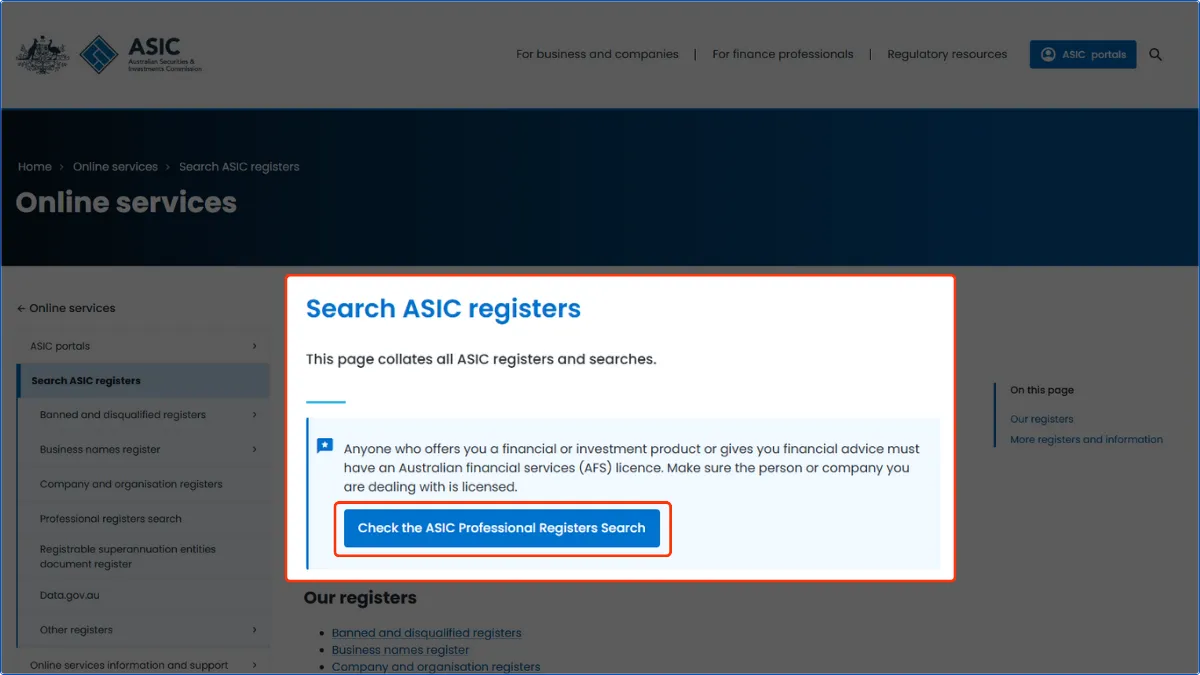
Official URL: Search ASIC registersClick the button "Check the ASIC Professional Registers Search" on the page to open the search interface.
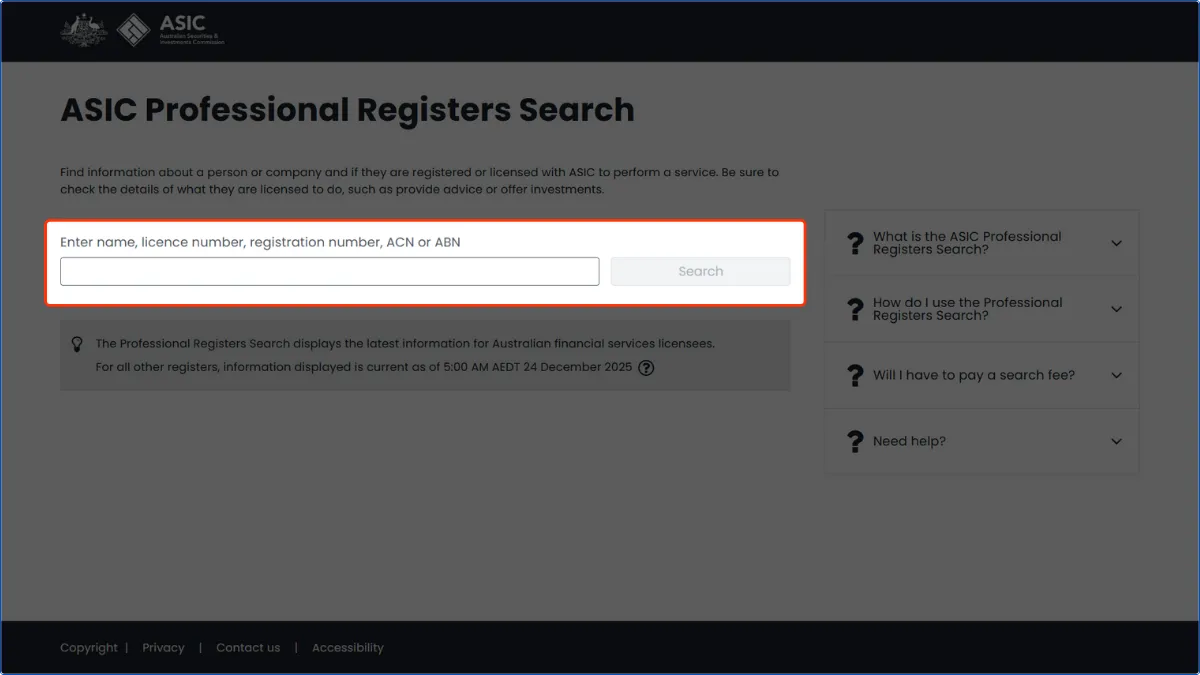
1. In the search box labeled "Enter name, licence number..." in the center of the screen, directly enter: 414530.
2. Click the "Search" button.
Step 3: Identify Search Results and Verify Details
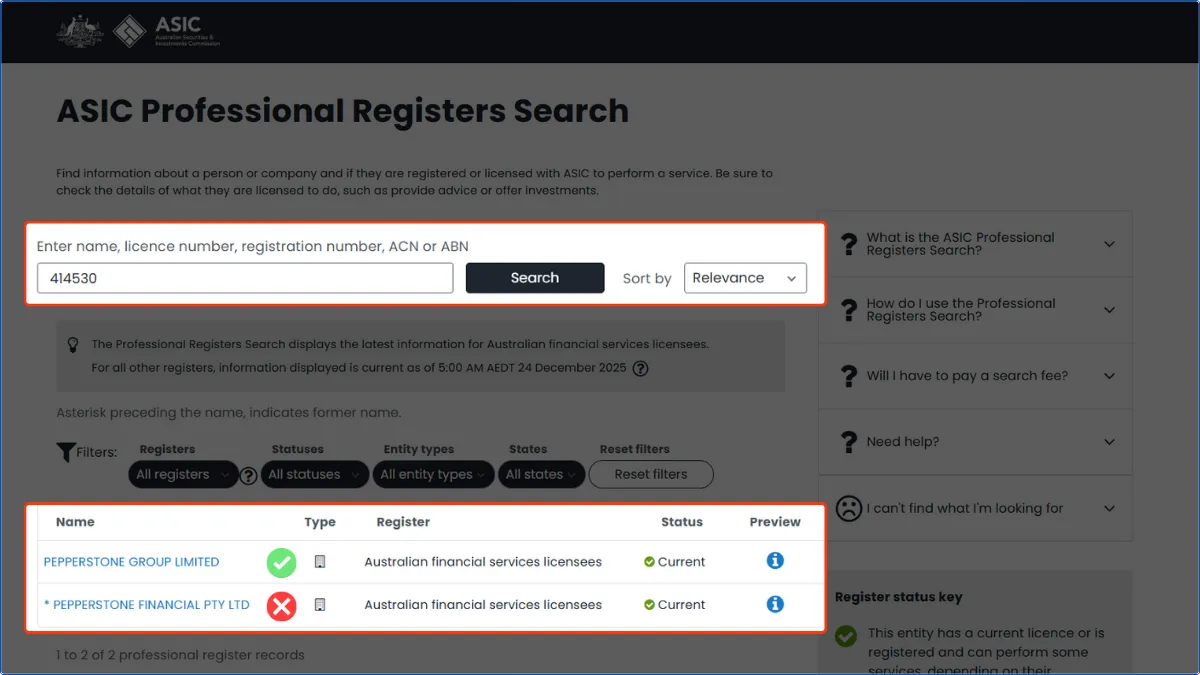
After searching, a list of results will appear (as shown in the image). Do not rush to a conclusion, as you may see multiple similar company names.1. Exclude "Former Names"
ASIC search results list all historical records under that license number. Please pay attention to the small print above the list: names with an asterisk (*) in front represent the company's old names.
For example, * PEPPERSTONE FINANCIAL PTY LTD appearing in the results is an old name, please do not click it.
2. Click on the Correct Company Entity
Please click the option "without an asterisk (*)" and where the name matches the legal terms on the website (in this case, "PEPPERSTONE GROUP LIMITED") to enter the details page.
3. Verify in the Details Page
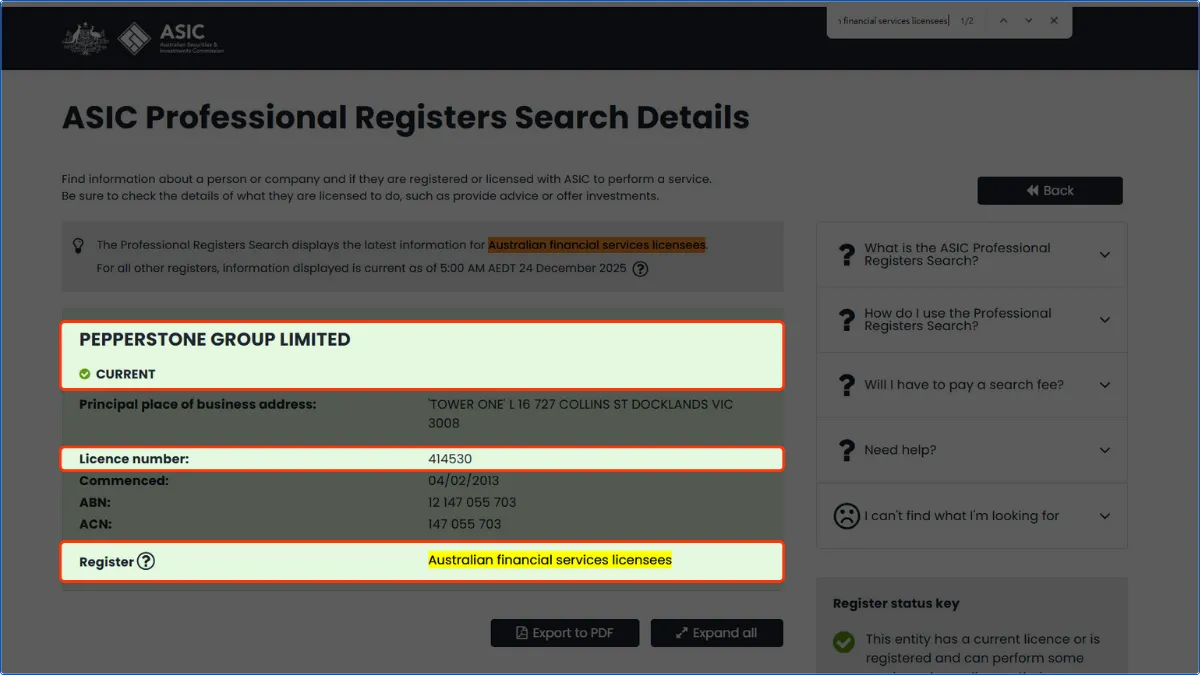
After entering the details page, please confirm if the following information matches:
Status:
Must show a green checkmark with "Current".
Licence number:
Confirm the number is 414530.
Register:
Should display as "Australian financial services licensees".
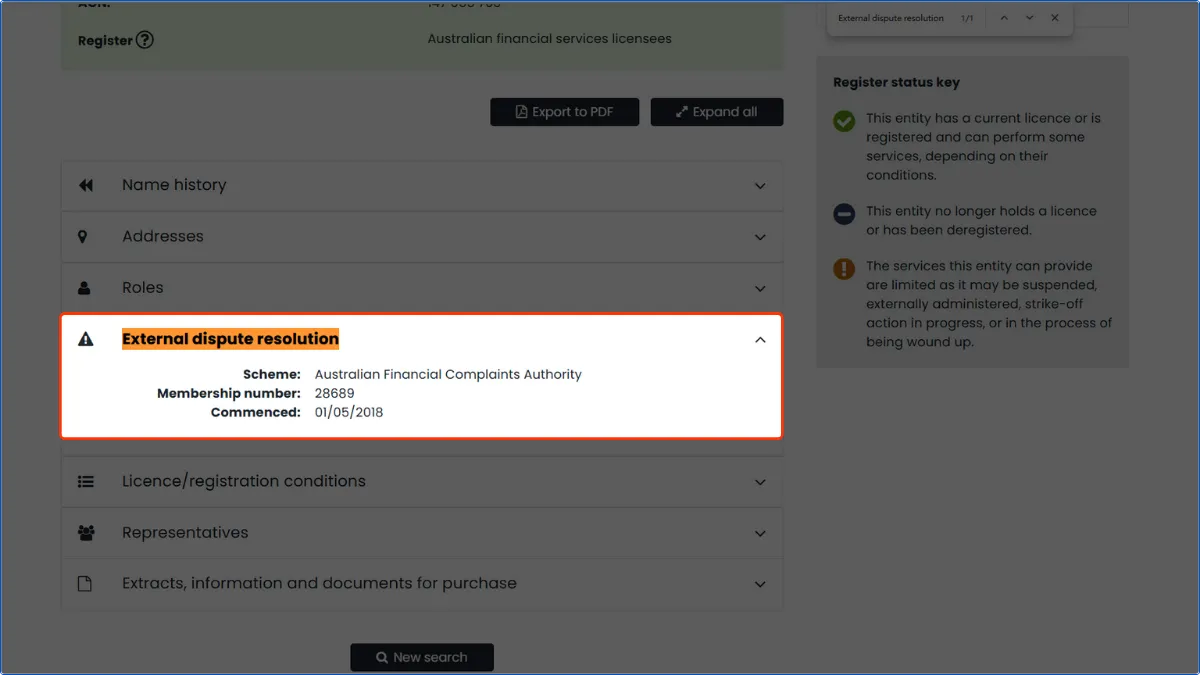
External Dispute Resolution:
This is the most important protection mechanism. Please find the "External dispute resolution" menu at the bottom of the page and click to expand it. Confirm its Scheme shows "Australian Financial Complaints Authority (AFCA)". This means if an unresolved dispute occurs, you can apply for third-party arbitration with AFCA.
Differences in Compensation Mechanisms: ASIC vs. FCA
Many people mistakenly believe that Australian regulation is the same as UK regulation, where the government provides compensation if the platform goes bankrupt. This is a common misconception.UK (FCA):
Has the FSCS scheme. If a broker goes bankrupt, the government guarantees compensation of up to £85,000.
Australia (ASIC):
Currently, for forex derivatives, there is no government-level "compensation scheme of last resort". ASIC's protection mechanism is: Mandating brokers to purchase PI Insurance (Professional Indemnity Insurance) and join AFCA. If a trading dispute occurs (such as inability to withdraw funds or slippage), AFCA can rule that the broker must compensate. However, if the broker goes directly bankrupt, the recovery of client funds usually requires a liquidation process, and there is no unconditional government payout.
Mr.Forex Viewpoint: regarding "fund protection after bankruptcy," the UK's FCA remains the highest global standard. Although ASIC regulation is strict, the compensation mechanism is slightly different.






 繁體中文
繁體中文  العربية
  বাংলা
বাংলা  简体中文
简体中文  香港中文
香港中文  Čeština
  Dansk
Dansk  Nederlands
  English
  Français
  Deutsch
  Ελληνικά
  हिन्दी
  Magyar
  Bahasa Indonesia
  Italiano
  日本語
日本語  한국어
한국어  Bahasa Melayu
  Norsk bokmål
  Polski
  Português do Brasil
  Português
  Română
  Русский
  Español de Argentina
  Español de México
  Español
  Svenska
  ไทย
ไทย  Türkçe
  Українська
  اردو
اردو  Tiếng Việt