
Mastering Forex Margin Trading: Start with Global Cash Flows
Stop following the herd. Start trading the trend.
Author: Mr.Forex
Welcome to the Forex Market
You might have heard that the stock market is huge—the NYSE trades about $20 billion daily. Sound like a lot? In reality, the Forex market’s daily volume reaches $6.6 trillion.If the stock market is a lake, Forex is the "Ocean of Finance." No single player can easily manipulate it (due to deep liquidity), and it runs 24 hours a day. But remember, giant sharks lurk in the deep. This guide provides the diving gear to understand the rules, helping you swim with sharks rather than becoming their lunch.
Forex Margin — Advantages and Costs
1. Why is it hard to build wealth with "Stocks"?
- Low Capital Efficiency: Traditional stocks usually have no or very low leverage. If your capital is $3,000, a 10% annual gain only nets you $300—hardly life-changing.
- Trading Restrictions: Many markets have T+1 or T+2 settlement limits. Without short-selling options, you can only watch helplessly during a bear market.
2. Three Major Advantages of Forex Margin
Focusing on CFD (Contract for Difference) features:Advantage A: Profit Amplification
- Concept: You don't need the full amount to buy currency; you only pay a "Margin."
- Stock Mode (1:1): You have $1,000. Price rises 1%, you earn $10. (Slow growth)
- Forex Mode (1:100): You have $1,000. Use leverage to control a $100,000 contract. Price rises 1%, you earn $1,000. (Capital doubled!)
- Conclusion: This is why retail traders love Forex—it allows small capital to roll over quickly.
Advantage B: Two-Way Trading, Fearless of Bear Markets
- People panic when stocks fall, but Forex traders don't care because currencies are traded in pairs. If EUR falls, USD rises.
- Just hit Sell (Short); the more the market drops, the more you profit.
- Quote: In Forex, there are no bull or bear markets—only "Volatility." Where there is volatility, there is opportunity.
Advantage C: 24-Hour Market (T+0)
- Busy during the day? No problem.
- The Forex market flows 24/5. The "Overlap of London/NY sessions" is usually the most volatile. Buy and sell anytime; your capital is never locked.
3. A Double-Edged Sword
Excited by the potential? Calm down first.Leverage is a double-edged sword:
- When the market moves 1% in your favor, your capital can double.
- When it moves 1% against you, your capital can vanish instantly.
Cruel Reality: When stocks drop, you can "HODL" and wait for a recovery. Forex margin has no 'buy and hold' strategy. Once losses hit the margin limit, the system executes a Stop Out, and your capital is gone.
Mr.Forex Summary: "Forex margin is like a 'Howitzer' (leverage). Use it well, and it blasts open the doors to wealth; use it poorly, and you’ll blow yourself up. This is why Risk Control is emphasized throughout this book."
The Food Chain: Who’s Playing the Game?
The essence of Forex is "International Trade" and "Capital Exchange."- The Whales: Central Banks
Role: Federal Reserve (Fed), European Central Bank (ECB).
Goal: Not purely for profit, but to "stabilize the national economy."
Impact: A single decision (rate hike or cut) can trigger massive waves in the market.
Mr.Forex Insight: Never fight the central bank. - The Sharks: Commercial Banks & Large Institutions
Role: Citibank, JPMorgan, Deutsche Bank.
Goal: Providing exchange services for MNCs and speculating for profit.
Impact: They determine short-term price fluctuations and market liquidity. - The Fish: Multinational Corporations (MNCs)
Role: Apple, Toyota.
Goal: Hedging and actual trade needs. For example, Toyota earns USD in the US and needs to exchange it back to JPY to pay salaries, creating "real demand." - The Shrimp: Retail Traders — That's Us
Role: Individual investors participating via Brokers.
Survival Rule: We can't move the market, we can only "follow the trend." Catch a ride on the traces left by the whales and sharks.
Understanding Currency Pairs and Product Characteristics
1. The Seesaw Principle
Forex trading always comes in pairs. EUR/USD = 1.1000The Base Currency (EUR): The first currency — viewed as the "Product."
The Quote Currency (USD): The second currency — viewed as the "Money."
Translation: You need to pay 1.1 US Dollars to buy 1 Euro. Going "Long" on EUR/USD means buying Euros while simultaneously selling US Dollars.
2. Which Currency Pairs Should Beginners Choose?
A. European & Safe-Haven Currencies
EUR/USD ⭐⭐⭐⭐⭐ *Best for BeginnersThe world's most traded pair with the most standard technical patterns.
USD/JPY ⭐⭐⭐⭐
Strong safe-haven properties, heavily influenced by US Treasury yields. Once a trend forms, it often leads to strong one-way movements.
GBP/USD ⭐⭐⭐
Higher volatility than EUR/USD with more aggressive movements and frequent fakeouts.
B. Commodity Currencies
USD/CAD ⭐⭐⭐Highly negatively correlated with crude oil prices (usually moves in the opposite direction).
AUD/USD ⭐⭐⭐⭐
Positively correlated with gold and mineral prices.
* These economies rely heavily on raw material exports, making their exchange rates closely linked to commodity prices.
C. Precious Metals
XAU/USD (Gold)Not a currency, but a "commodity." Its volatility is typically 2-3 times that of normal currency pairs. Fast profits but extremely high risk ⚡.
⚠️ WARNING: Beginners are advised to only observe for the first 3 months or practice with 0.01 lots. Do not trade it like a regular currency pair.
Mr.Forex Warning: Beginners should stay away from "Cross Pairs (e.g., GBP/JPY)" and "Exotics (e.g., USD/TRY)." High spreads and extreme volatility can be overwhelming.
Leverage & Margin: Like a "Down Payment on a House"
Forex margin amplifies profits, working just like paying a small down payment to control the title of a large property.1. The Essence of Leverage
Leverage allows you to control high-value contracts with a small amount of "Used Margin" (deposit).1:100 Leverage Example: Suppose you want to control a property worth 10 million. The broker allows you to pay only 100,000 as a down payment (margin) to secure the contract. This 100,000 is the "Used Margin" required to open your position.
2. Account Safety Check
- Equity:
Calculated as "Account Balance + Floating Profit/Loss." This is your actual "real asset" at any given moment. - Stop Out (Liquidation):
Think of it like falling house prices. If the price drops so much that your down payment is nearly gone, the bank will foreclose on the house (Stop Out) to mitigate risk. In Forex, there is no "holding forever"—once a Stop Out is triggered, your capital vanishes instantly.
Pips, Lots, and Profit/Loss Calculation
1. What are "Pips" and "Points"?
This is often the most confusing part of the Forex market. Traditionally, prices are quoted to 4 decimal places (called a Pip), but modern platforms (like MT4/MT5) use 5 decimal places for precision (called a Point).- Pip: The second-to-last digit of a quote. This is the standard unit for calculating profit/loss and setting stop losses.
- Point (Pipette): The very last digit of a quote. 10 points equal 1 standard pip.
【Practical Example: Understanding Quote Movements】
- EUR/USD: 1.10021 → 1.10031
The second-to-last digit changed by 1, meaning the price rose by 1 Pip, or 10 Points. - USD/JPY: 150.533 → 150.543
The second-to-last digit changed by 1, also representing a 1 Pip price increase.
Mr.Forex Tip:
If you follow a signal and hear "Stop Loss 30," always clarify: do they mean 30 Pips (standard) or 30 Points (micro)? There is a 10x difference! While MT4/MT5 usually requires price inputs, you must calculate the exact price coordinate for those 30 pips to avoid massive risk errors.
2. What is a "Lot"?
A "Lot" is the unit of trade volume, determining how much each pip movement is worth:- 1.00 Standard Lot = 100,000 units of base currency.
- 0.10 Mini Lot = 10,000 units of base currency.
- 0.01 Micro Lot = 1,000 units of base currency.
3. Core Profit/Loss Formula
For pairs with USD as the quote currency (like EUR/USD), remember this golden rule:Trading 0.1 Lot, 1 Pip movement ≈ $1 USD
Calculation: 100,000 units × 0.1 Lot × 0.0001 Pip = 1 USD
(Note: P/L is based on your account currency. For USD/JPY, a 1-pip move earns JPY, which the system automatically converts to USD for display.)
Mr.Forex Summary: This means if you trade 1 standard lot, a 1-pip move is worth $10. Before entering a trade, calculate a lot size your capital can handle!
Hidden Costs: Don't Let Sharks Steal Your Profits
1. Spread — The Broker's Admission Fee
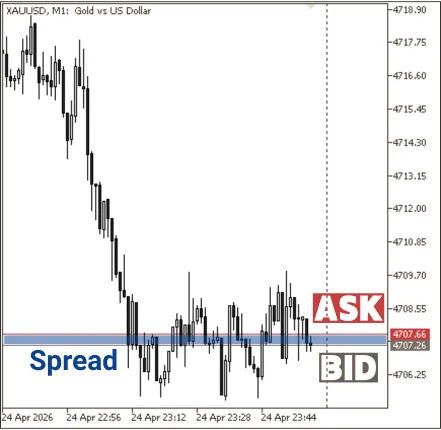
Why are there always two prices on Forex software? Think of it like "exchanging currency" at a bank:- Ask Price: The price you "Buy" from the market (represented by the Red Line). Like buying USD from a bank, the price is always higher.
- Bid Price: The price you "Sell" to the market (represented by the Gray Line). Like selling leftover USD back to the bank, the price is always lower.
The difference between these two is the Spread. This is why your profit/loss usually starts as a "negative number" the moment you open a trade—you've already paid this admission fee to the broker (refer to the Red Line (Ask) and Gray Line (Bid) in the figure).
2. Swap — The Interest Cost of Holding Positions
Forex trading involves the exchange of two currencies, which naturally creates an interest rate differential. If your position remains open past the daily settlement time (00:00 server time, also known as Rollover):- Earn Interest (Positive Swap): When you buy a high-interest currency (e.g., USD) and sell a low-interest currency (e.g., JPY).
- Pay Interest (Negative Swap): Conversely, if you hold a currency with a lower interest rate, you will incur an interest cost.
- Special Note: Since the Forex market is closed on weekends, banks account for Saturday and Sunday interest in advance. Therefore, "holding a position overnight on Wednesday" usually incurs Triple Swap.
Conclusion: Ready for Action
You have now mastered the rules of the game, the scoring (pips and lots), the logic (buy and sell), and the costs (spreads and swaps).Next, pick up your phone. I will show you how to install the trading platform, log into a demo account, and complete your first trade within 5 minutes.




 繁體中文
繁體中文  العربية
  বাংলা
বাংলা  简体中文
简体中文  香港中文
香港中文  Čeština
  Dansk
Dansk  Nederlands
  English
  Français
  Deutsch
  Ελληνικά
  हिन्दी
  Magyar
  Bahasa Indonesia
  Italiano
  日本語
日本語  한국어
한국어  Bahasa Melayu
  Norsk bokmål
  Polski
  Português do Brasil
  Português
  Română
  Русский
  Español de Argentina
  Español de México
  Español
  Svenska
  ไทย
ไทย  Türkçe
  Українська
  اردو
اردو  Tiếng Việt